
P-01 · Featured · the graph database behind this site

Connect everything. See further.
Galactus DB is a modern property-graph database for the real world — scalable, fast and built for what's next. Parameterised Cypher over Bolt 4.4, native drivers for seven languages, and vector, spatial and full-text indexes with graph analytics built in. It ships as a statically linked Rust binary in a scratch container.
It's also what's running underneath this city: every conversation with the agents in the plaza, their knowledge base (searched with Galactus DB's BM25 full-text index) and every enquiry lives in Galactus DB, reached through its native Rust driver.
- Container image
- 5.9 MB
- Idle memory
- 8.1 MB
- Index-seek latency vs Neo4j
- ~½
- Node bulk-load rate vs Neo4j
- 1.9×
Cypher, with APOC built in
Parameterised Cypher with selected APOC functions and procedures. Bolt 4.4 means existing Neo4j-compatible tooling connects.
Every index you need
Vector, spatial, full-text, hash, range, composite and element indexes — similarity search sits next to the graph, not in another system.
Graph analytics
Communities, ranking and shortest paths on a graph projection, with resource limits per job.
Tiny footprint
Graph structure and indexes in memory, base properties on disk with a bounded cache. Linux AMD64 and ARM64 via Docker.
Explorer workbench
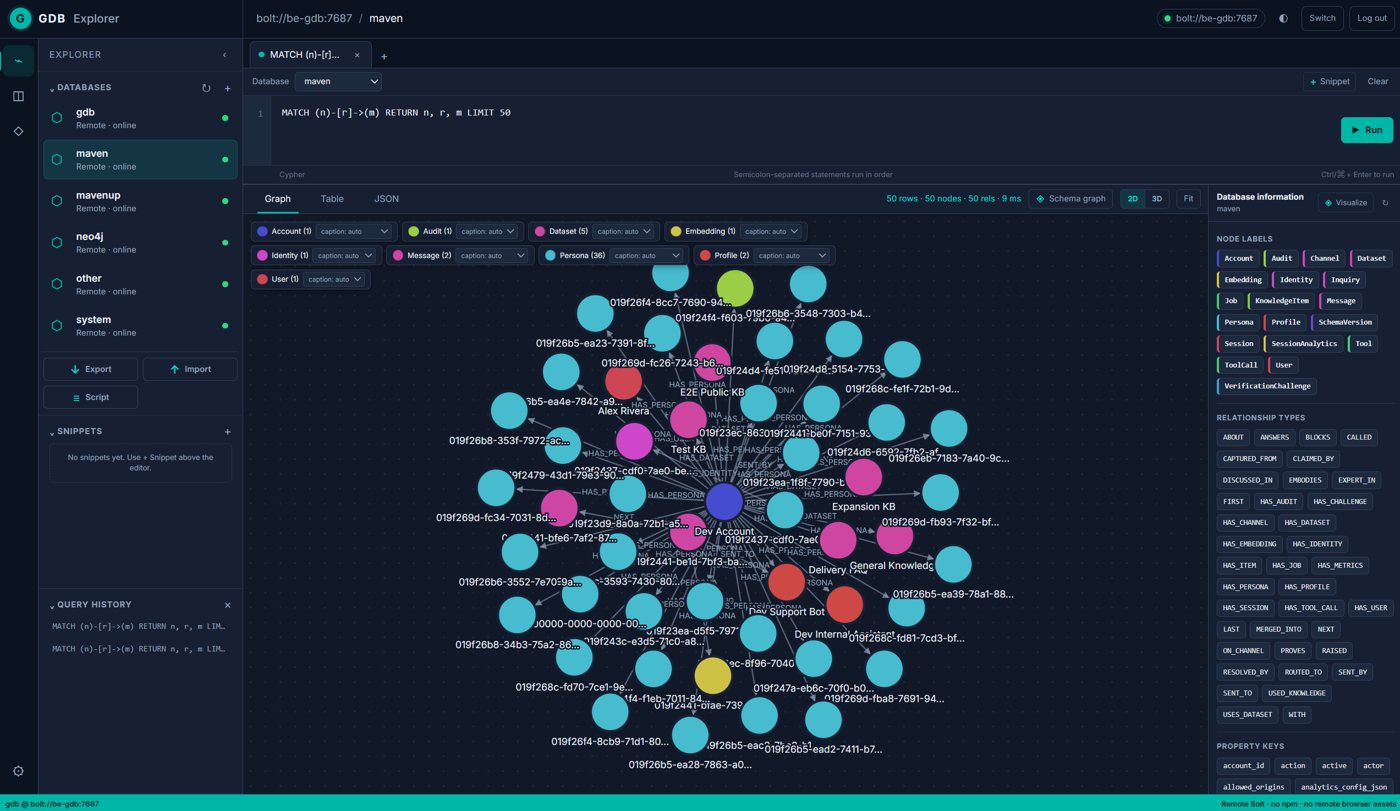
A browser workbench to get to know your graph: graph, spatial, table and JSON views.
Native drivers
C#, Rust, Java, Go, Node, C++ and Python — early access, source available on GitHub.
Questions
What is Galactus DB?
A self-hosted property-graph database written in Rust. It speaks parameterised Cypher over Bolt 4.4 and includes vector, spatial and full-text indexes plus graph analytics, in a container of about 6 MB.
Does it work with Neo4j tools?
It speaks Bolt 4.4 with parameterised Cypher and selected APOC functions and procedures, so existing Neo4j-compatible tooling can connect.
Where does it run?
On Linux AMD64 and ARM64 via Docker, with native drivers for C#, Rust, Java, Go, Node, C++ and Python.
Figures from galactusdb.com. Benchmarks against Neo4j 5.26.30 Community: 100,000 people and 200,000 relationships on 8 CPU / 8 GB containers, medians of three passes. The 1.9× bulk-load figure is for the default buffered durability mode (1.5× in durable group mode). Neo4j was about 2.5× faster on filtered label scans.